Cedric Montiano · AI, Automation & Data Solutions
Selected Systems Portfolio · 2026 · ECE

Fragmented operations, made governed, automated & measurable.

I design and implement systems that connect operational data capture, validation, automation, analytics and AI-assisted decision support — with a strong emphasis on governance, human validation, access control and measurable operational value.

  • AI Implementation
  • Workflow Automation
  • Cloud Applications
  • Data Platforms
  • Operational Analytics
Mandaluyong City, NCR · PH cedricmontiano@gmail.com
8 FTE
Capacity released
Management/PCM-assessed; redeployable to higher-value work.
~₱240K
Monthly labor capacity
Management-estimated requirement reduction.
90–95%
Reporting timeliness gain
From ~1 day to under 2 hours / same-day visibility.
44,580
Verified audit events
Zero backlog, zero duplicate ledger rows in isolated test.
01Profile

PM and practitioner across operations, data and AI implementation.

Project Manager and AI/Automation practitioner with a background in operations management, data analytics, workflow engineering, cloud application development and implementation.

My portfolio spans deployed operational dashboards, project-management platforms, data-governance systems, spreadsheet modernization, forecasting workflows, planning engines and internal data-quality tools.

Across these projects, AI is used where it adds value — analysis, recommendations, development acceleration, structured assistance — while deterministic logic remains the control layer for validation, permissions, calculations and workflow rules.

Core capabilities → evidence across portfolio

AI implementation & responsible use
Vertex AI/Gemini management analysis; evidence-constrained AI; planned human-in-the-loop agent architecture; analyst validation.
Workflow automation
Chat-based reporting workflows, Apps Script pipelines, scheduled automation, Cloud Functions, Cloud Scheduler, Windows Task Scheduler.
Data platforms & governance
Firestore, BigQuery, PostgreSQL RLS, Cloudflare D1, SQLite, immutable history, audit trails, validation pipelines.
Application engineering
React, TypeScript, Fastify, Next.js, AG Grid, Firebase, serverless APIs, contract-first OpenAPI design.
Operational analytics
KPI engines, management reporting, forecasting, milestone/SLA models, scenario planning, risk and capacity analysis.
Implementation leadership
Problem framing, stakeholder requirements, prototyping, testing, rollout planning, capability-building, documentation and adoption.

Portfolio disclosure: operational source data and some upstream processes are team-generated. This portfolio focuses on systems I designed, built, implemented, integrated, tested or materially refined; where an upstream component is external or collaborative, wording describes integration and contribution rather than sole ownership. Public visuals use synthetic or anonymized data.

02Case Studies

Five systems, five different engineering problems.

Not a collection of identical dashboards — each project below solves a distinct problem in how operational work is captured, governed, analyzed and managed.

Case Study 01Production

NAPA Operations Automation & AI Management Dashboard

End-to-end reporting automation, data-quality control, operational analytics and AI-assisted management intelligence for national field operations.
Operational AutomationAnalyticsAI Implementation Google Sheets · Apps Script · Firebase Hosting · Cloud Functions · Firestore · Firebase Auth/Storage · Vanilla JS · Chart.js · Vertex AI / Gemini
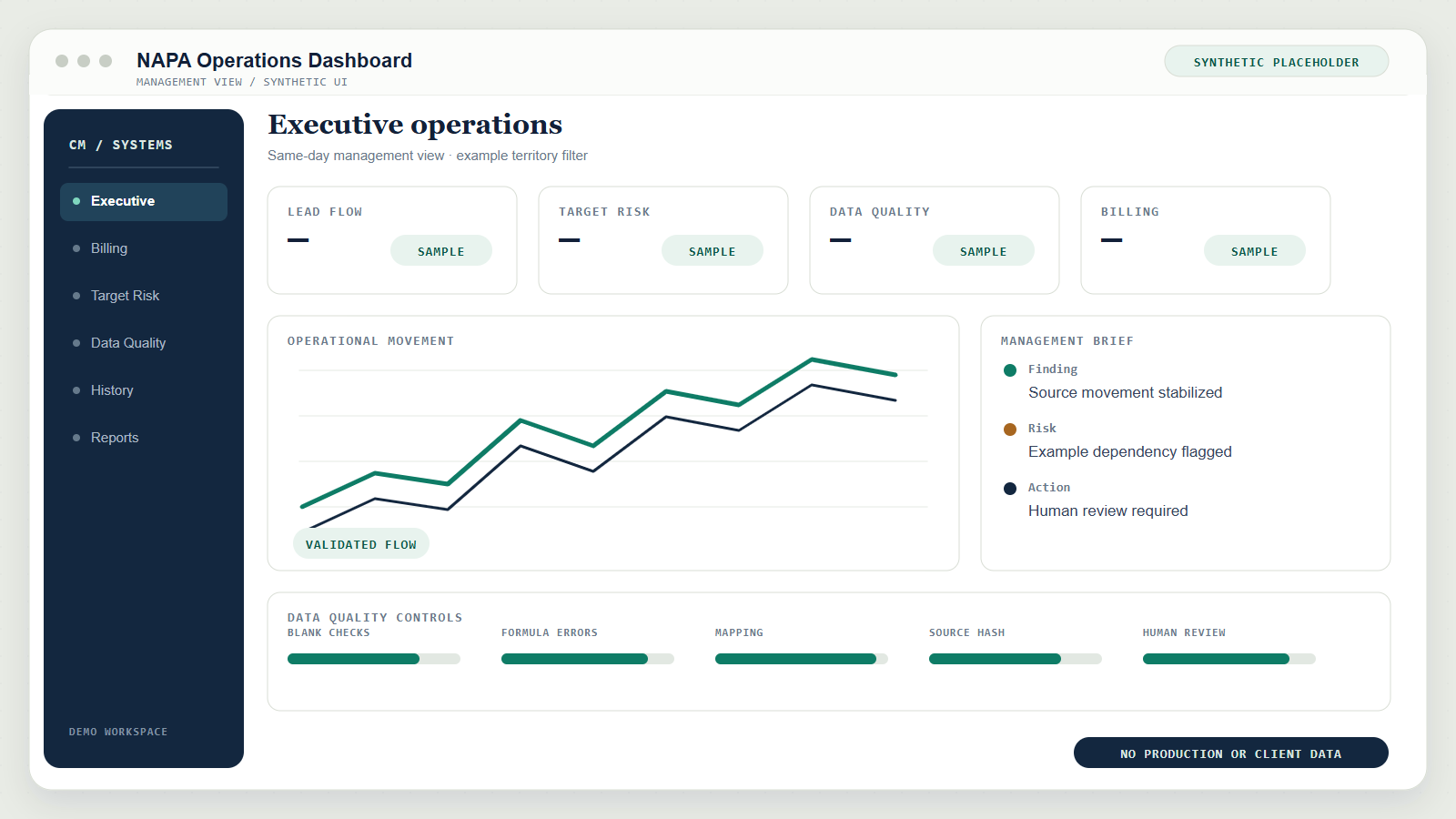
Synthetic placeholder of the NAPA Operations Dashboard with KPI cards, movement charts, a management brief and data-quality controls.
Synthetic UI placeholderReplace with an anonymized production screenshot

The situation

Regional field reporting and project tracking relied on multiple operational spreadsheets and manual consolidation — producing reporting delays, inconsistent values, broken formulas, repeated handling and limited management visibility before national numbers could support decisions.

Role: built the dashboard and core data/analytics layers; developed and refined automation workflows around an external chat-based reporting process using AI-assisted development; led automation adoption and capability-building.

The build

  • External field reporting — structured Telegram/chat submissions routed through cloud workflow automation and LLM-assisted parsing into operational spreadsheets.
  • Data-quality pipeline — Apps Script extraction, cleaning, validation, broken-formula/blank/error checks, mapping and consolidation before national reporting.
  • Production dashboard — Firebase-hosted SPA behind Cloud Functions data gateways, with authentication, user approval, module-level access control and source history.
  • Runtime AI — Vertex AI / Gemini structured outputs for management briefs and analytics interpretation; generated numerics checked against known metrics.
  • Historical traceability — daily source snapshots, hashes, archives and NAP-level change history for management review.
  • RTA / lead indicators
  • Executive summary
  • Billing
  • Ask NAPA analytics
  • Management brief
  • Target-risk control
  • History & changes
  • Data quality
  • Report builder
  • Masterplan
  • Action board
8 FTE
Capacity released
Redeployable to higher-value work.
~₱240K
Monthly labor capacity
Management-estimated reduction.
<2 hrs
Same-day visibility
Down from ~1 day (90–95% timeliness).
66.7%
Processing staffing cut
12 roles → 4 QC-focused roles in assessed model.
·Estimated 95%+ reduction in transmission-related errors; 99%+ data consistency after validation controls. ·Quality-response cycle improved from next-day to ~2–3 hours.
NoteAll figures are management-assessed within the NAPA + FTTH process model; upstream chat-based automation is external to the audited repository.

What this demonstrates

a.

Translating an operational reporting problem into an integrated automation, data-quality, analytics and AI solution.

b.

Practical AI with structured outputs, evidence checking and human review — not unrestricted AI decision-making.

c.

Cloud application delivery, KPI design, source-history tracking and stakeholder-oriented reporting.

d.

Automation leadership: initiating structured learning, coaching team members, enabling recurring workflow automation.
Case Study 02Pre-Production

FiberHome PULSE

Next-generation multi-project operations platform: from dashboard-centric reporting to governed project workflows.

Product ArchitecturePlatform Engineering React · TypeScript · Vite · Fastify · PostgreSQL 18 · Drizzle · TypeBox/OpenAPI · Generated API Client · Playwright · Terraform
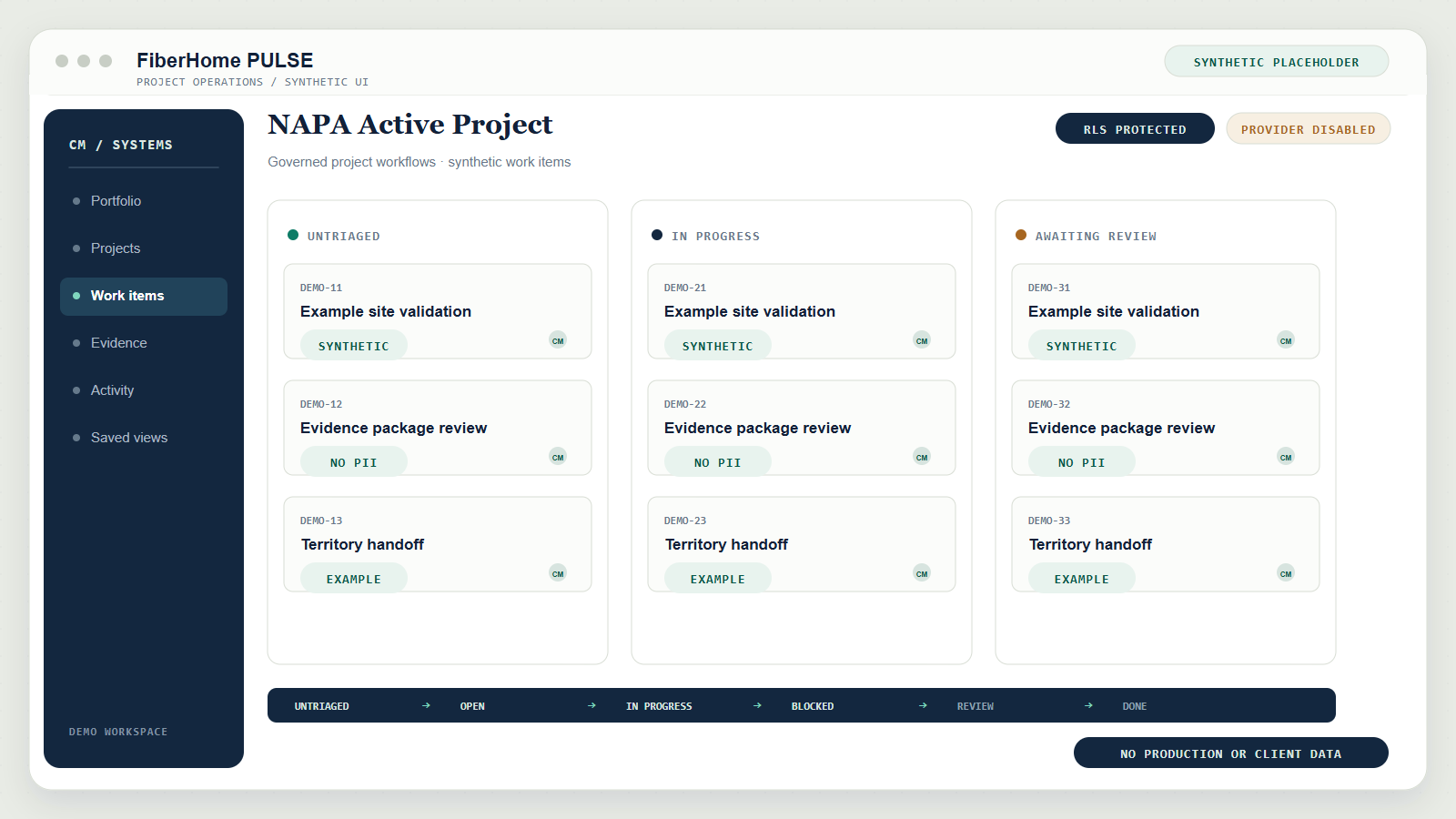
Synthetic placeholder of FiberHome PULSE showing governed work-item boards, workflow states and row-level-security status.
Synthetic UI placeholderReplace with an anonymized product screenshot

Why PULSE exists

PULSE is a from-scratch successor architecture for the existing dashboard ecosystem. Instead of adding more dashboards around operational data, it reorganizes the product around projects, work items, governed state transitions, owners, evidence, collaboration and auditability — closer to a Jira/Monday-style project operations platform adapted to telecommunications delivery.

Milestone posture: loopback-only local compositions, production fail-closed guard, synthetic seed opt-in, Terraform deployment gates — no live production connection by design.

The build

  • Monorepo architecture — separate web app, Fastify REST API, importer, shared TypeBox/OpenAPI contracts, domain package, database package and generated API client.
  • PostgreSQL 18, 36 tables — organizations, workspaces, memberships, projects, work items, evidence, collaboration, activity, artifacts, source snapshots, AI governance.
  • Row-Level Security everywhere — database-level RLS across all tables; restricted runtime roles with user/workspace identity injected transaction-locally for every query.
  • Contract-first API — OpenAPI generated from shared schemas, generated client types, CI drift detection, Idempotency-Key support, ETag/If-Match optimistic concurrency.
  • Deterministic workflow — role-gated state transitions with required blocker/resolution notes:
  • untriaged
  • open
  • in progress
  • blocked
  • awaiting review
  • done / cancelled
  • Multi-org workspaces
  • Work items + evidence
  • Comments & watchers
  • Saved views
  • Immutable activity events
  • Transactional outbox
  • Idempotency records
  • Source snapshots
  • Typecheck · lint · unit · RLS tests
  • 50K-row pagination test
  • Playwright E2E
Ask PULSE·AI-ready but intentionally disabled — agent threads, runs, tool calls, approval requests, quotas and immutable snapshot references are modeled; provider execution has no activation path until approvals and deployment gates are ready. Side-effecting actions require approval; AI context pins to validated snapshots.

What this demonstrates

a.

Recognizing when a dashboard-centric system needs a stronger domain model and workflow foundation.

b.

SaaS-style multi-tenancy, relational modeling, database-level authorization and API contract engineering.

c.

Concurrency, idempotency, auditability, source provenance and migration-safe design patterns.

d.

Responsible AI architecture: deliberately disabling provider execution until data, permissions, approvals and deployment gates are ready.

Case Study 03Pre-Production

NAPA Spreadsheet Audit

External audit logging, data-governance and reliability engineering for large spreadsheet operations — without touching the spreadsheet itself.

Cloud GovernanceAudit LoggingReliability Apps Script · Cloud Functions Gen 2 · Node.js · Firestore · BigQuery · React · TypeScript · AG Grid · Firebase Auth/App Check
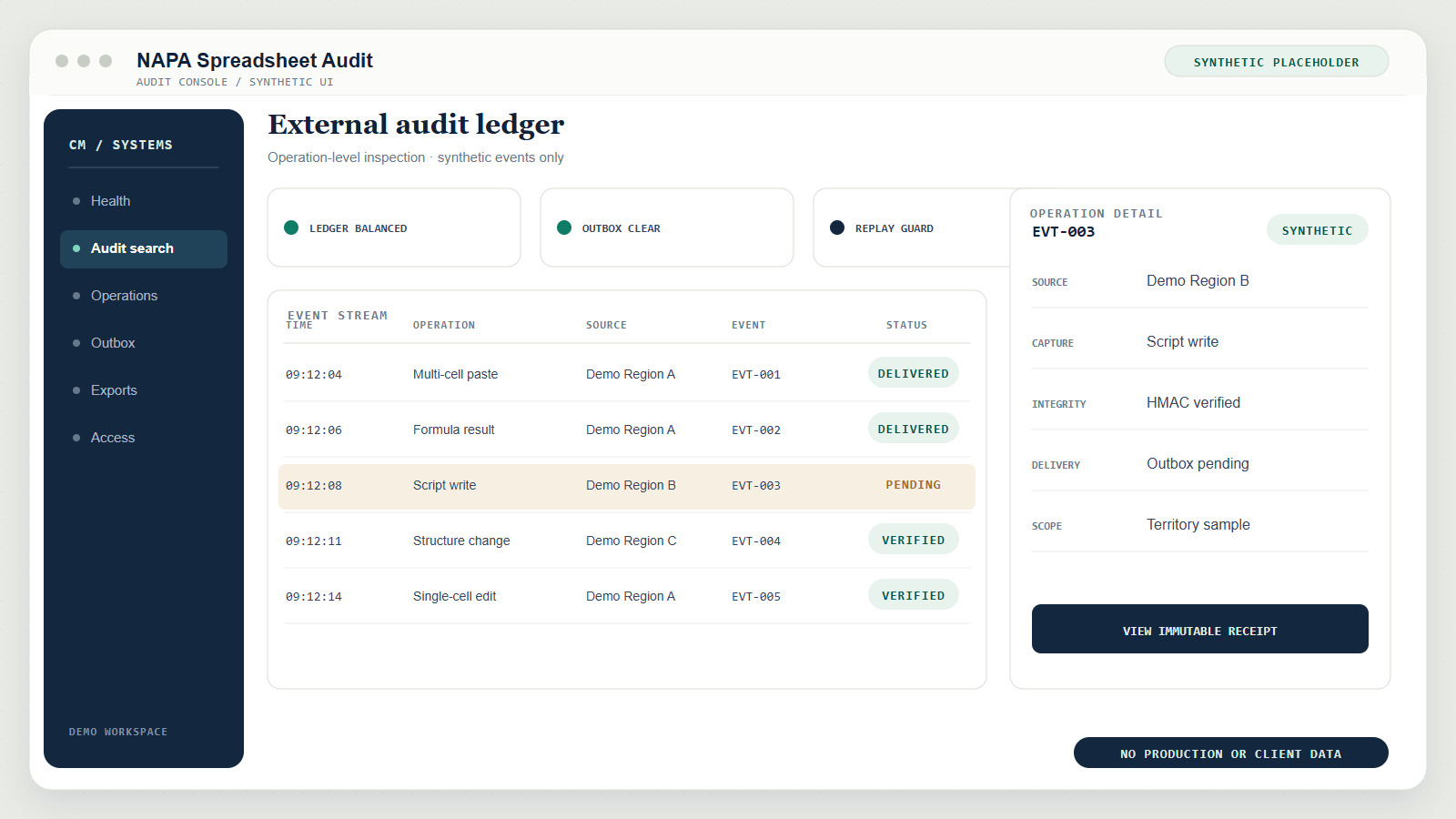
Synthetic placeholder of the NAPA Spreadsheet Audit console with event ledger, health indicators and operation details.
Synthetic UI placeholderReplace with an anonymized audit-console screenshot

The problem

Large operational spreadsheets are edited manually, pasted into in bulk, updated by scripts and recalculated by formulas — while native history provides limited granular attribution. The challenge: a durable external audit trail with zero structural footprint — no helper columns, no logging tabs, no formula changes.

Role: system design and engineering focused on non-invasive capture, event reliability, secure querying, governance and test validation.

The pipeline

  • Capture — Apps Script observes single-cell edits, multi-cell pastes, controlled script writes, formula result changes and structural events.
  • Sign — events are bounded, hashed and signed (HMAC-SHA-256) with timestamp + nonce replay protection before HTTPS ingestion.
  • Ingest & buffer — Cloud Functions validate source and payload; Firestore transactions manage batch manifests, receipts, segmented row shadows and a durable outbox.
  • Deliver — scheduled outbox worker performs idempotent BigQuery MERGE, verifying event IDs before completion; BigQuery is the append-only permanent ledger, Firestore the operational state layer.
  • Inspect — React/AG Grid console: protected audit search, operation-level inspection, territory-scoped access, sanitized CSV export, health monitoring.
  • Harden — server-enforced authorization, deny-all direct client access, signed cursors, parameterized queries, formula-safe export; automated format/lint/type/test/secret gates.
14,124
Source rows
Full isolated bootstrap/reconciliation.
44,580
Verified events
Zero backlog, zero duplicate ledger rows.
2,248
Queued batches
Successfully drained after bootstrap.
0
Unaccounted events
Integrity model holds end-to-end.
Received=Delivered+Pending+Failed-Retryable → Unaccounted = 0·source spreadsheet structure remains unchanged

What this demonstrates

a.

Event-driven architecture and non-invasive integration with legacy operational tools.

b.

Transactional outbox, idempotent delivery, replay protection, immutable storage and failure recovery.

c.

Cloud security, territory-scoped access, data-governance thinking and operational observability.

d.

Deterministic engineering rather than unnecessary runtime AI.

Case Study 04Prototype

Fieldline Tracker

Spreadsheet-style operational platform with centralized data, controlled access and multi-user editing safeguards.

Spreadsheet ModernizationData Platform React 19 · TypeScript · Vite · AG Grid Community · Cloud Firestore · Firebase Auth/Hosting · Vitest
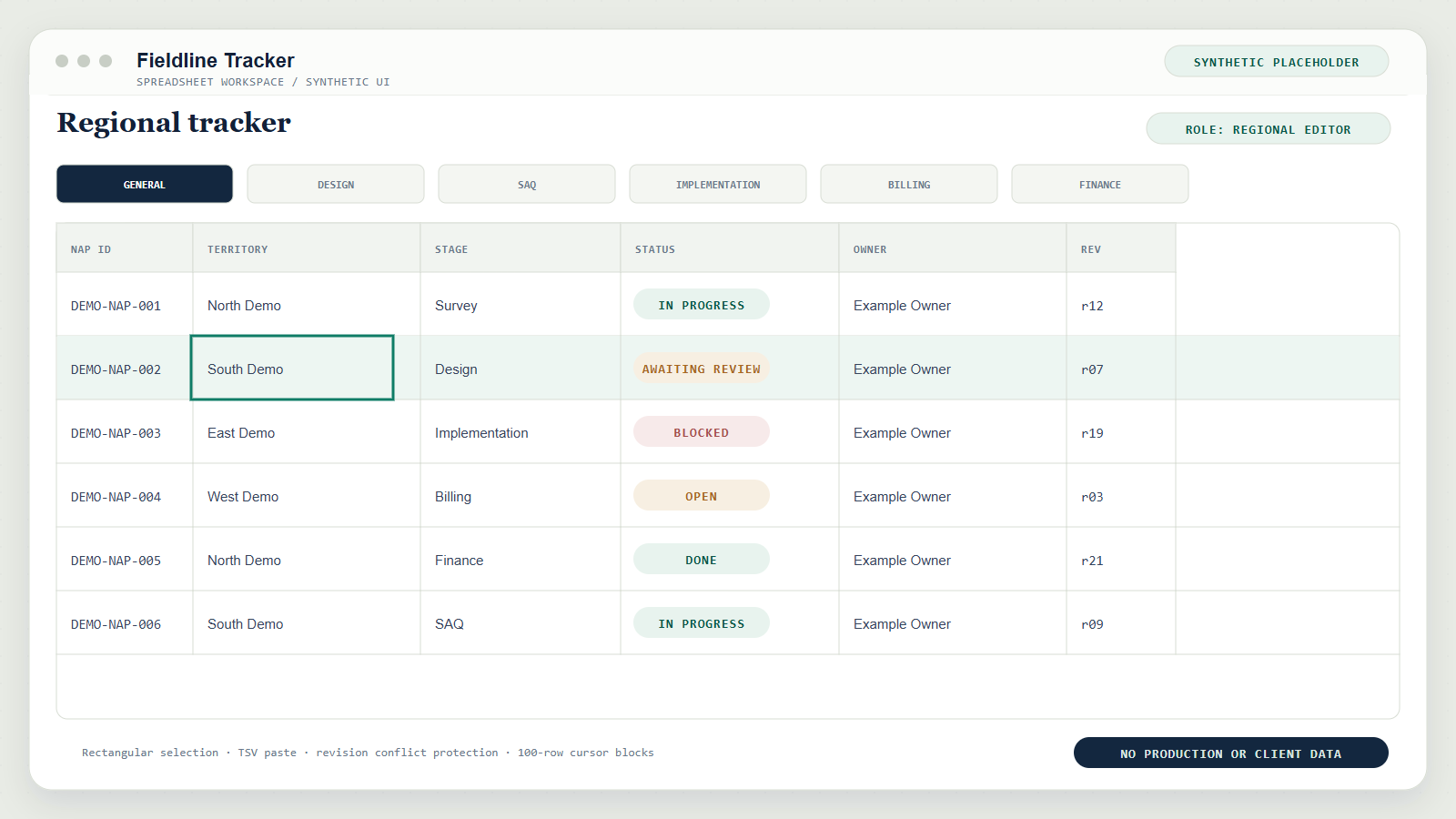
Synthetic placeholder of Fieldline Tracker showing a regional operational grid, stage and status cells, role controls and revision values.
Synthetic UI placeholderReplace with an anonymized tracker screenshot

The goal

Fragmented regional spreadsheets create version-control pain, duplicated consolidation and no access control. The design bet was not to abandon the familiar spreadsheet interaction model — but to preserve its productivity while replacing the file-based architecture underneath with a centralized, governed application.

Role: independent engineering project using AI-assisted development; focused on grid UX, data architecture, security, validation and scalability.

The build

  • Spreadsheet-grade UX — inline editing, custom rectangular multi-cell selection, TSV copy/paste, Fill Down, Fill Series, saved views, session undo/redo.
  • Scale discipline — infinite row model over Firestore cursor pagination: 100-row blocks, bounded five-block cache, virtualized DOM instead of loading the dataset.
  • Partitioned data model — six collections separating General, Design, Site Acquisition, Implementation, Billing and Finance domains.
  • Enforced RBAC — seven roles across five regional territories, enforced in the UI and at the Firestore Security Rules boundary.
  • Concurrency safety — atomic transactions with revision numbers reject stale edits; main grid updates are request-based while row-level discussions stream real-time.
  • Validated at scale — automated tests plus synthetic load: 13,000 tracker rows / 78,000 documents.

What this demonstrates

a.

Advanced spreadsheet interaction without relying on a commercial enterprise grid package.

b.

Large-data UX: cursor pagination, virtualized rendering, memory-bounded client behavior.

c.

Database-enforced RBAC, regional scoping, domain isolation and multi-user concurrency protection.

d.

AI-assisted software development while keeping application behavior deterministic and auditable.

Case Study 05Personal

AI-Assisted Agricultural Statistics Forecasting

Personal forecasting and validation workflow — auxiliary analytical evidence for analysts reviewing survey results, never a replacement for official methodology.

ForecastingDecision Support Python · VS Code · Statistical Models · ChatGPT/Gemini-assisted Analysis · Power BI
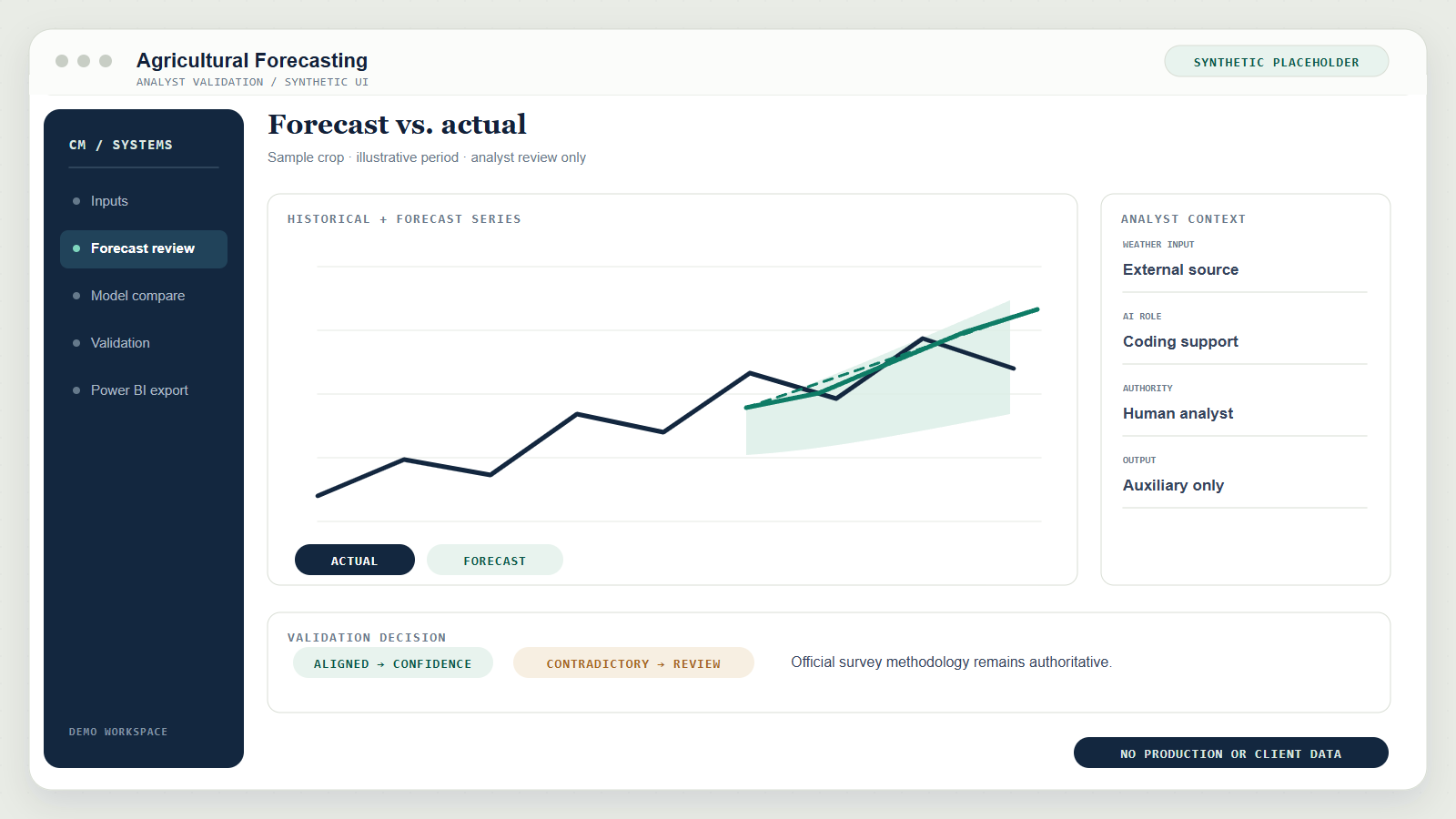
Synthetic placeholder of an agricultural forecasting review with actual-versus-forecast lines, confidence band and analyst-validation context.
Synthetic UI placeholderReplace with an anonymized Power BI or analysis screenshot

The objective

Explore whether historical agricultural statistics, contextual weather information and statistical forecasting could provide a useful independent reference point for analysts reviewing survey results. The forecast was treated strictly as auxiliary evidence: agreement increased confidence; contradiction triggered closer review — never automatic rejection of official results.

The workflow

  • Sourcing — historical production/area/yield series gathered from official PSA publications.
  • Weather context — rainfall/temperature identified via AI-assisted research but sourced from external data, never generated as fact.
  • Preparation — Python for cleaning, alignment, merging and transformation in VS Code; AI tools supported coding and model exploration under human validation.
  • Modeling — time-series, regression and alternative statistical approaches evaluated against historical patterns.
  • Validation — forecasts compared with actual survey results; split outcome: aligned → confidence up, contradictory → further review.
  • Delivery — Power BI visuals of trends, forecast-vs-actual and explanatory views for analyst review.
Human judgment and official survey methodology remain authoritative.· AI as analyst assistant — not a substitute for statistical methodology

What this demonstrates

a.

Analytical foundations in forecasting, statistical reasoning, data preparation and visualization.

b.

Appropriate generative-AI use as analyst/development assistant under human-in-the-loop validation.

c.

Contradictions trigger review; alignment supports confidence but never creates official results.

d.

Connecting domain context, external variables and quantitative models into a repeatable workflow.

03Supporting Engineering Systems

NAPA planning & decision intelligence.

Presented as supporting case studies rather than flagships — together they show the depth behind the production dashboard: deterministic planning, SLA modeling, evidence-constrained AI, reconciliation and privacy-oriented reporting.

SYS AOperational · Local

NAPA Forecast Control Tower

Planning, scenario analysis, risk/capacity modeling, materials recovery and evidence-controlled AI briefing. Not cloud-deployed.

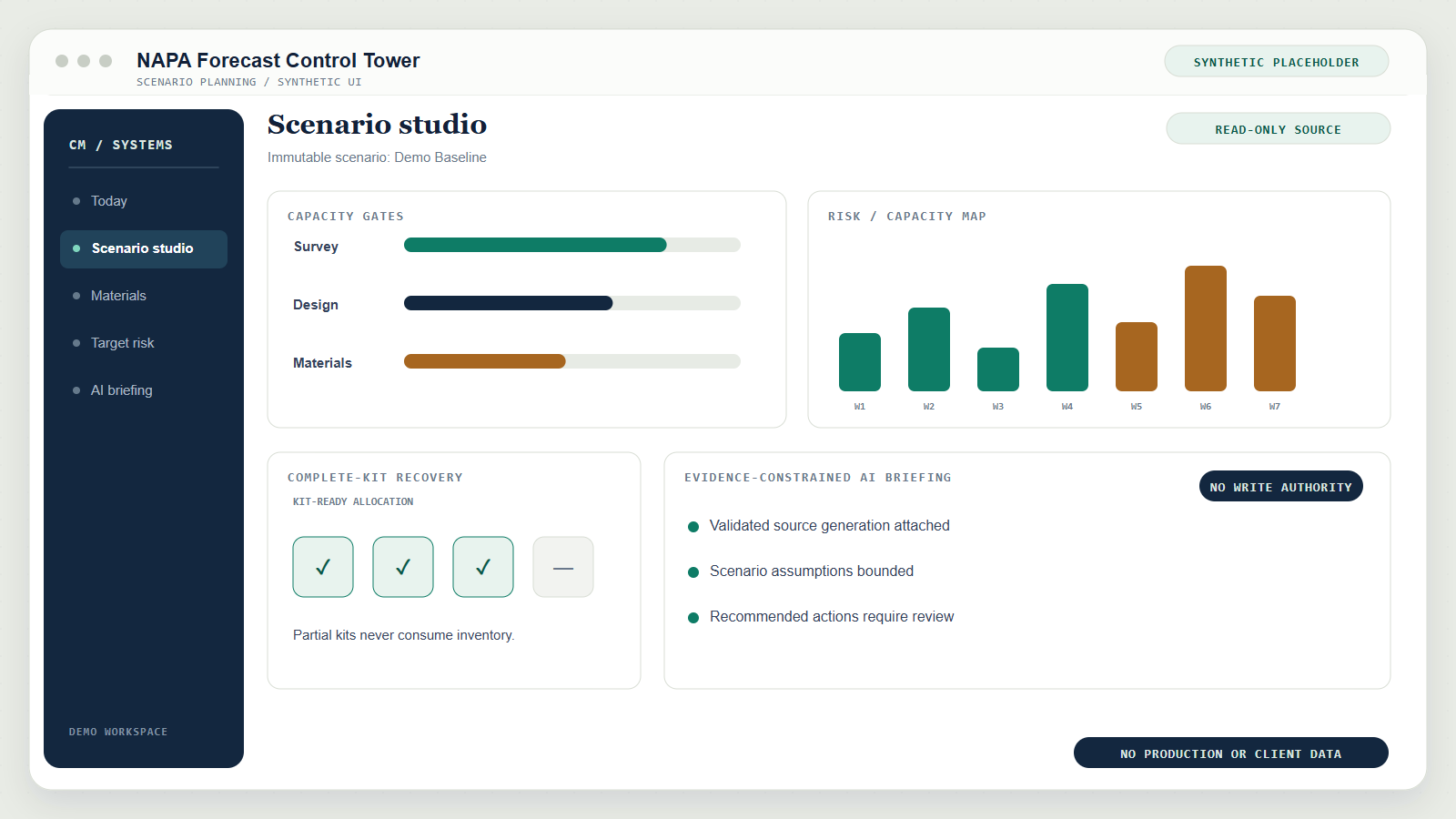
Synthetic placeholder of the Forecast Control Tower with capacity gates, a risk map, materials recovery and an evidence-constrained AI brief.
PlaceholderSynthetic interface
  • Read-only acquisition via Sheets/Drive scopes; Drive revision checked before and after fetch to reject inconsistent reads.
  • Deterministic scenario engine: goal-seek, stress testing, sequential capacity gates, named immutable scenario revisions.
  • Materials recovery uses complete-kit-only allocation — partial kits never consume inventory.
  • AI analyst: structured JSON, bounded evidence, zero-data-retention routing, post-generation factual validation. No authority to modify source data.
  • Scheduled refresh, history capture and briefing run via Windows Task Scheduler / PowerShell.

Python · PowerShell · Windows Task Scheduler · Google Sheets/Drive APIs · OpenRouter / DeepSeek · Local server

SYS BFunctional

PM SLA Target Engine

Milestone target-setting, SLA logic, capacity/RACI planning, actions, overrides, history and masterplan exports.

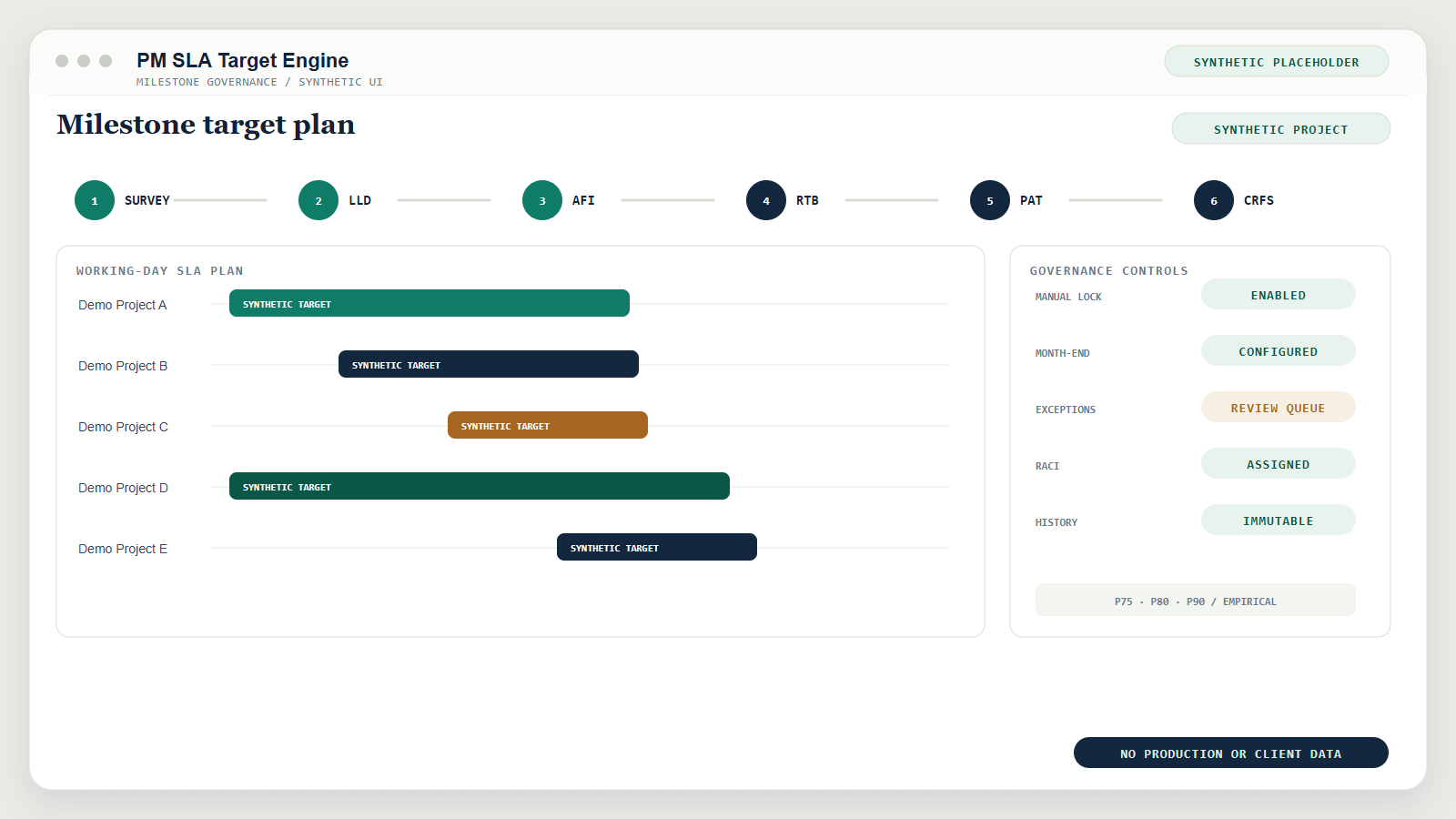
Synthetic placeholder of the PM SLA Target Engine with milestone timeline, working-day plan and governance controls.
PlaceholderSynthetic interface
  • Apps Script engine manages milestones across the delivery chain with working-day SLA logic.
  • Chunked execution + LockService serialization stay inside runtime limits and prevent overlapping runs.
  • Blue/green-style import: alternate snapshots with atomic publish reduce corruption during refresh.
  • Manual target locks, month-end rollover, exceptions, capacity configuration, RACI, owner directory, action logs and history modeled explicitly.
  • Python companion performs empirical SLA analysis and scorecards — explicitly no ML claim.
  1. SURVEY
  2. LLD
  3. AFI
  4. RTB
  5. PAT
  6. CRFS

Apps Script · Google Sheets · Python · Node.js test harness

SYS CFunctional QA

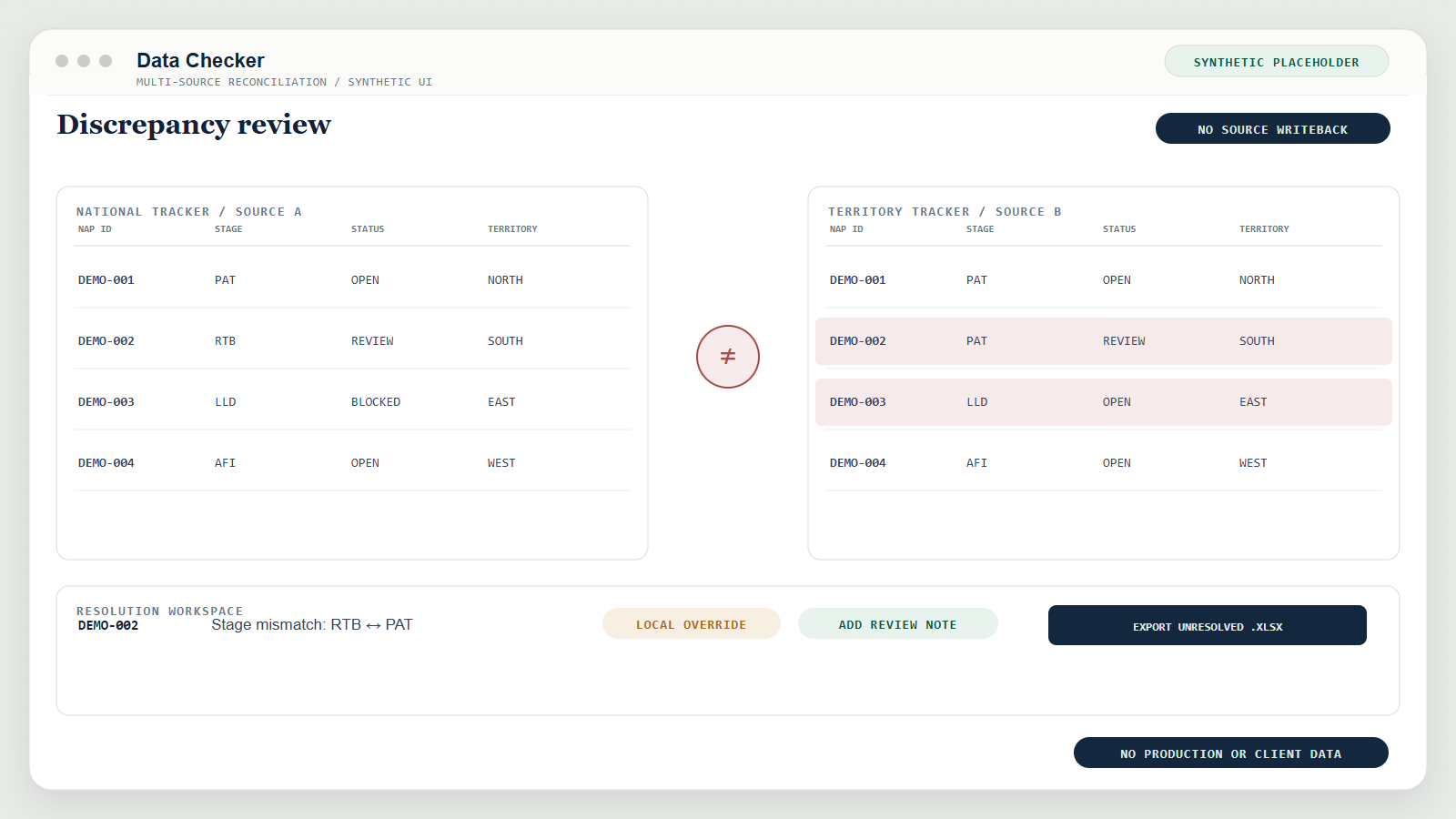
Data Checker — Multi-Source Reconciliation

Detect cross-tracker discrepancies, record controlled local resolutions and export reconciled outputs. Never writes back to source spreadsheets.

Synthetic placeholder of Data Checker with side-by-side tracker discrepancies and a local resolution workspace.
PlaceholderSynthetic interface
  • Ingests national and territory trackers via Sheets API with dynamic NAP/stage/status/territory column mapping.
  • Groups records by NAP identifier and flags stage, status and territory mismatches across sources.
  • Resolution workflow records local overrides and notes — no writeback to Google Sheets.
  • Exports reconciled national output or unresolved endorsement list as Excel files.

Next.js 16 · React 19 · TypeScript · Prisma · SQLite · Google Sheets API · SheetJS

SYS DProduction-Ready

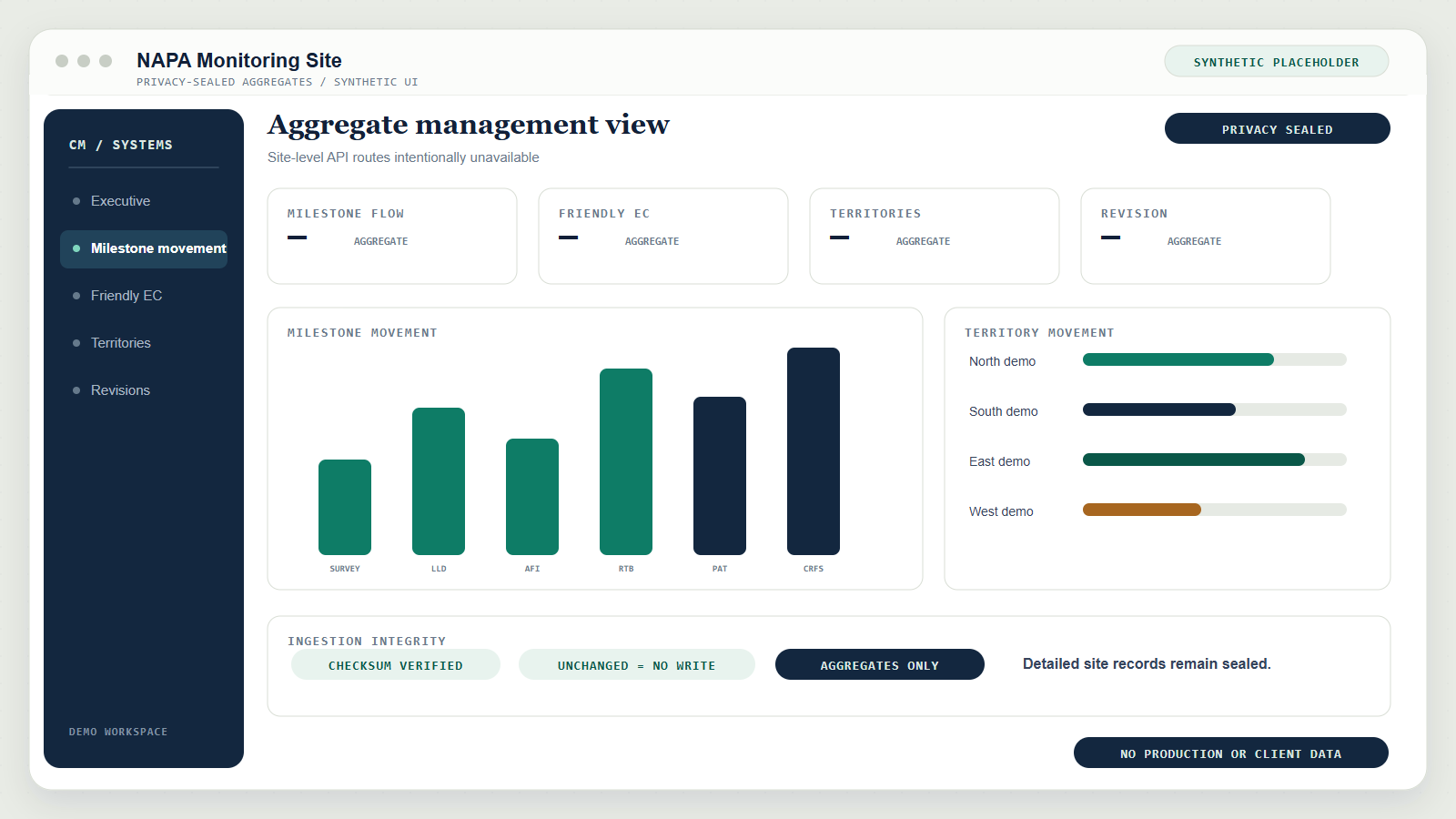
NAPA Monitoring Site — Privacy-Sealed Reporting

Aggregate milestone and EC reporting for management while deliberately sealing site-level records.

Synthetic placeholder of the NAPA Monitoring Site with aggregate milestone charts, territory movement and privacy-seal controls.
PlaceholderSynthetic interface
  • Publishes aggregate milestone-movement and Friendly EC dashboards for executive and territory views.
  • D1 stores daily aggregate runs, checksums, ingestion attempts, revisions and internal change history.
  • Idempotent ingestion validates raw + canonical SHA-256 checksums before creating any new revision.
  • Public site-level API routes deliberately return 404 — detailed site history stays private.
  • Embed protocol: iframe auto-resize, theme sync and filter reset via postMessage.

Next.js 16 · React 19 · Cloudflare Workers · Cloudflare D1 · Drizzle · Tailwind CSS

04Architecture Evolution

How the projects fit together.

Each project's distinct story

NAPA Dashboard

Automate the existing operating process; deliver same-day management visibility with measured value.

FiberHome PULSE

Re-architect dashboard-centric operations into a multi-project workflow platform with relational security and API contracts.

Spreadsheet Audit

Add reliable, tamper-resistant external history and governance without modifying the working spreadsheet.

Fieldline Tracker

Preserve spreadsheet productivity while replacing fragmented files with a controlled web application.

Agricultural Forecasting

Statistical forecasting and AI-assisted analysis as auxiliary evidence for human decisions.

Control Tower / SLA Engine

Deterministic planning, scenarios, capacity/SLA governance and evidence-controlled AI.

Data Checker / Monitoring

Stronger data quality and management reporting through focused internal tools.

Evolution of the NAPA product family

  1. Automate field reporting

    Improve data quality around the existing operational process.

  2. Production dashboard

    Build a management dashboard and AI-assisted reporting layer for national visibility.

  3. Deepen the platform

    Planning, target-risk, SLA, history, reconciliation and monitoring capabilities.

  4. Recognize the ceiling

    Continually expanding a dashboard-centric architecture hits limits.

  5. Design PULSE

    A new project/work-item operating platform: relational data, governed workflows, database-level RLS, safe future AI.

05Technology & Implementation Matrix

Breadth, with honest status labels.

ProjectApplication / Data StackAI / AnalyticsStatus
NAPA DashboardFirebase, Cloud Functions, Firestore, Sheets, Apps Script, JSVertex AI / GeminiProduction
FiberHome PULSEReact, Fastify, PostgreSQL 18, RLS, OpenAPI, TerraformGoverned Ask PULSE architecture; provider disabledPre-Production
Spreadsheet AuditApps Script, Cloud Functions, Firestore, BigQuery, React/AG GridDeterministicPre-Production
Fieldline TrackerReact, AG Grid, Firestore, Firebase Auth/HostingNo runtime AI; AI-assisted developmentPre-Production
Agri ForecastingPython, statistics, Power BIAI-assisted analysis + forecastingPersonal
Control TowerPython, PowerShell, Google APIs, local serverOpenRouter / DeepSeek, evidence-validatedLocal Ops
PM SLA EngineApps Script, Sheets, PythonEmpirical statistics, no MLFunctional
Data CheckerNext.js, Prisma, SQLite, Sheets APIDeterministic QAFunctional
Monitoring SiteNext.js, Cloudflare Workers/D1, DrizzleDeterministic analyticsFunctional
  • Human validation for AI-generated analysis and recommendations.

  • Deterministic controls for permissions, workflow transitions, calculations, validation and integrity rules.

  • Least-privilege access and server/database-enforced authorization wherever sensitive data is involved.

  • Explicit distinction between deployed, pre-production, prototype and planned functionality.

  • Quantified impact only when backed by management assessment or verified testing — no invented ROI.

  • Synthetic/anonymized portfolio visuals to protect operational and client information.

Roles this portfolio supports

AI Automation Engineer Intelligent Automation Engineer AI Solutions Engineer Technical Solutions Engineer AI Implementation Specialist GenAI Process Automation Engineer Technical Solutions Consultant PM — AI, Automation & Data Solutions
06Closing · Implementation Approach
Understand the workflow first. Automate what repeats. Preserve human review where judgment matters.

I approach AI and automation projects as implementation problems, not only model-selection problems. The recurring pattern: understand the operational workflow, define the data and control boundaries, automate what is repeatable, keep humans where judgment matters, and build enough validation and observability that the system can be trusted in day-to-day work. The portfolio shows the corresponding evolution — from spreadsheet automation and dashboards toward governed data platforms, secure APIs, relational domain models, concurrency controls, source provenance, auditability and human-gated AI.

Name

Cedric H. Montiano, ECE

Project Management · AI Implementation · Automation · Data & Operational Systems

Location

Mandaluyong City,
NCR, Philippines